Why Language Cafés and Exchanges Are the Best Way to Practice Speaking
Discover the thriving world of language exchanges across European cities—from Barcelona's intercambios to Berlin's Sprachcafés. Learn how to find partners, make lasting connections, and accelerate your speaking skills.
Why Language Exchanges Are the Best Kept Secret for Fluency
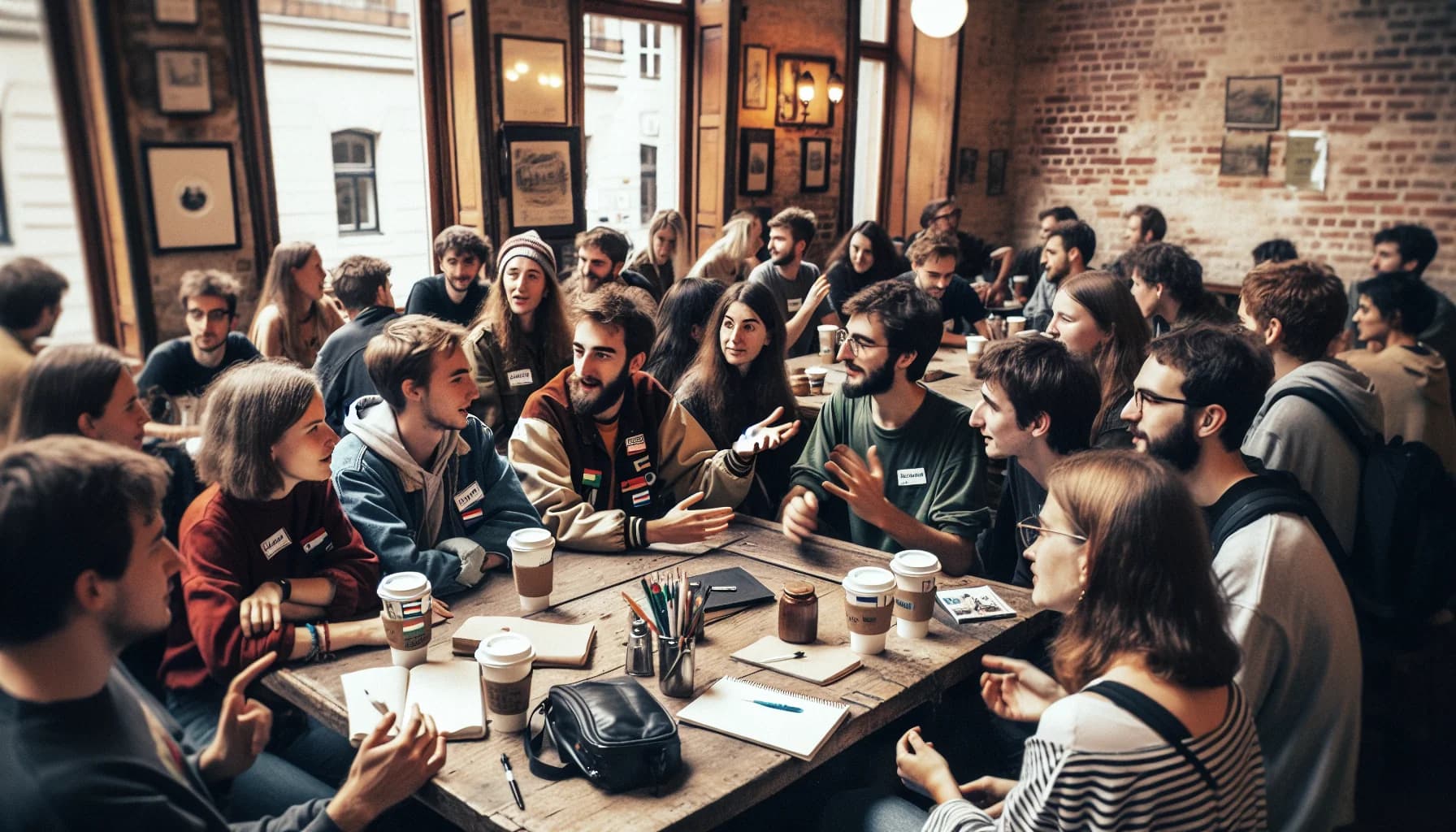
Picture this: a dimly lit café in Berlin, tables pushed together, strangers becoming friends over mediocre coffee and shared linguistic stumbling. One hour German, one hour English, everyone making mistakes and nobody minding. This is the language exchange—a simple idea that's transformed how millions of people actually learn to speak a foreign language.
Unlike traditional classes with their grammar drills and textbook dialogues, language exchanges throw you straight into authentic conversation. There's no teacher correcting your every mistake, no pressure to perform for a grade. Just two people who each have something the other wants: fluency in a foreign tongue.
The concept has exploded across European cities over the past decade. What started as informal meetups in university common rooms has evolved into a thriving culture of organized events, dedicated cafés, and international communities. From Madrid's weekly intercambios to Stockholm's språkkafé gatherings, millions of Europeans have discovered that the fastest path to speaking confidence isn't through an app or a classroom—it's through genuine human connection.
Research backs up what exchange participants have known intuitively: speaking with real people activates different learning pathways than solitary study. Your brain encodes language more deeply when there's social context, emotional connection, and the stakes of real-time communication. You don't just learn words—you learn how people actually use them.
What Actually Happens at a Language Café or Exchange Event
If you've never attended one, language exchanges can seem intimidating. Walking into a room full of strangers, knowing you'll have to stumble through conversations in a language you barely speak—it's enough to keep most people scrolling through Duolingo instead.
Here's what typically happens: You arrive at a café, bar, or community center that hosts regular events. Organizers usually provide name tags with flag stickers showing which languages you speak and which you're learning. You find a partner or join a small group where there's mutual interest—maybe you speak French and want to learn German, and your partner speaks German and wants French.
You chat. That's really it. Most events use a timer system—thirty minutes in one language, then switch. This ensures neither party dominates and both get genuine practice time. The conversations range from small talk about your day to heated debates about politics, depending on how comfortable people get.
The atmosphere is unlike any classroom. Everyone is simultaneously teacher and student, expert and beginner. This levels the playing field in a remarkable way. The confident German businessman stumbles through his beginner Spanish just like the shy university student fumbles through basic German. Mistakes become normal, expected, even celebrated.
Most exchanges have regular attendees who become familiar faces over weeks and months. Real friendships form. Travel buddies meet. Romances bloom. Some of the most enduring friendships you'll make abroad can start with halting sentences and lots of hand gestures at a language exchange table.
Where to Find the Best Language Exchanges Across Europe
Different cities have developed their own language exchange cultures, each with a distinctive flavor. Knowing where to look and what to expect can make the difference between a frustrating evening and a life-changing connection.
Barcelona and Madrid lead Europe in organized language exchange culture. Spain's intercambio scene is legendary—bars host multiple events weekly with hundreds of attendees. The Spanish are famously sociable, and their exchanges reflect this: expect loud conversations, late nights, and impromptu tapas runs.
- Barcelona Language Exchange – Weekly Wednesday and Thursday exchanges
- Speaking Social Barcelona – One of the city's most active groups
- Barcelona Languages & Friends – Events almost every night of the week
- Spanish & International Friends Madrid – Thursday exchanges in the capital
- Madrid Expats – Language exchange combined with trivia nights
- Mucho Bueno Madrid – Wednesday exchanges in Malasaña
Berlin attracts language learners from everywhere, creating one of the most diverse exchange scenes on the continent. Events at venues like Denizen or regular meetups at local Kneipen draw everyone from Turkish engineers learning German to American artists practicing their third language. The city's anything-goes attitude makes it particularly welcoming for beginners afraid of judgment.
- Berlin Lingua Hub – Sprachcafé events for all levels, German-Spanish tandem
- German English Language Exchange in Berlin – Weekly Kreuzberg meetups
- Polyglots of Berlin – French, German, and multilingual evenings
- Berlin Sprachcafé – Focused on German A1-A2 learners
- Socialize in German – Large Monday and Thursday gatherings
Paris presents a more formal exchange culture, reflecting French attitudes about language and culture. Structured events with rotating conversations and strict timing are common. Parisians take pride in their language, so expect more correction and guidance than you might get elsewhere—which can be incredibly valuable if you want to speak properly.
- ChitChat Language Exchange – Thursday international nights with 90+ attendees
- Paris with Internationals and Locals – Tuesday language exchanges
- All Languages Club Paris – Every Monday plus themed events
- Paris Multi-Language Meetup – Friday polyglot gatherings
- The English Gengoffee – Franco-English apéro exchanges
Amsterdam, Copenhagen, and Stockholm have smaller but highly active exchange communities. In these cities where everyone speaks perfect English, finding opportunities to practice the local language can be challenging. Exchanges become essential—sometimes the only place where locals are willing to speak anything but English with you.
- Amsterdam Language Café – Facebook group for finding partners
- Meetup Amsterdam Language Exchange – Search for current active groups
- Stockholm Språkkafé – Swedish practice for internationals
- Copenhagen Language Exchange – Active Danish practice groups
Prague, Budapest, Warsaw, and Kraków have seen their exchange scenes explode as more internationals move to Central Europe. These events often draw locals genuinely curious about meeting foreigners, not just practicing English, which can create more balanced partnerships.
- Prague Language Exchange – Czech practice with expat community
- Budapest Language Exchange – Active Facebook community
- Warsaw Language Exchange – Growing Polish practice community
- Polyglot Warsaw – Multilingual meetups and language tables
- Kraków Language Exchange – Polish practice meetups
Lisbon and Porto have become magnets for remote workers and digital nomads, spawning vibrant exchange communities in co-working spaces and renovated industrial buildings. The Portuguese are notoriously difficult to practice with—they switch to English at the first sign of struggle—so structured exchanges become crucial for serious learners.
- Lisbon Language Exchange – Portuguese practice events
- Porto Language Café – Growing community in Porto
Why Traditional Classes Can't Replicate What Exchanges Offer
Language schools serve a purpose. Grammar explanations, structured progression, qualified teachers—these things matter. But traditional classes have inherent limitations that exchanges naturally overcome.
The talking time problem is the most obvious. In a class of ten students meeting twice weekly, your actual speaking time might total ten minutes per week. At a two-hour exchange, you're speaking for a full hour—and listening to authentic, unscripted speech for another. The sheer volume of practice is incomparable.
Classes also suffer from artificial dialogue. Even the best role-playing exercises feel performative. Both parties know the script, or at least the expected structure. There's no genuine information gap—nothing you actually need to communicate. At an exchange, you're having real conversations about real life. You want to know where your partner grew up, what they think about the election, why they're learning your language. The communication is authentic.
Then there's the motivation problem. Classes require discipline: showing up to assigned times, completing homework, preparing for tests. Many learners burn out or lose interest. Exchanges, by contrast, become social events you look forward to. The motivation is intrinsic—you genuinely want to meet these people and communicate with them.
Finally, classes often leave students with perfectly grammatical sentences that sound nothing like how natives actually talk. Real speakers use slang, contractions, sentence fragments, cultural references. They interrupt, overlap, trail off. At exchanges, you absorb these patterns naturally because you're immersed in authentic speech, not textbook dialogues recorded in sterile studios.
How to Find and Keep a Great Language Exchange Partner
While group events are fantastic for casual practice, the real magic happens when you find a dedicated one-on-one partner. Someone you meet regularly, whose progress you follow, who becomes invested in your improvement as you become invested in theirs.
Finding this person takes some effort. Group exchanges are the best recruiting ground—you'll naturally click with some people more than others. After a few events, suggest meeting separately: "Would you want to grab coffee next week and practice more?" Most people are flattered and eager.
Look for partners at roughly your target language level or slightly above. If there's too big a gap, the conversation becomes frustrating for the advanced speaker and intimidating for the beginner. Ideally, you can push each other to grow without either party feeling like they're only teaching.
Establish clear expectations early. How often will you meet? For how long? Will you strictly alternate languages or mix freely? What do you each want to focus on—conversation practice, pronunciation, specific vocabulary? Partners who agree on structure upfront avoid the resentment that can build when one person feels they're giving more than getting.
The best partnerships develop genuine friendship beyond language practice. You share interests, enjoy each other's company, have things to talk about beyond "what did you do this weekend." When the relationship transcends transactional language exchange, both parties stay motivated through the inevitable plateaus and frustrations.
But life interferes. Your partner moves away. Schedules stop aligning. Interest fades. Jobs change. Travel separates you for months. This is the unavoidable fragility of exchange partnerships—and why many learners cycle through multiple partners over years of study.
How Technology Changed Language Exchanges Forever
Before smartphones and reliable video calling, language exchanges required physical presence. You had to live in a city with enough speakers of your target language, find events near you, and coordinate schedules for in-person meetings. This limited who could participate and how often.
Apps like Tandem, HelloTalk, and Speaky democratized the exchange concept. Suddenly someone in rural Norway could find Mandarin speakers in Shanghai. A night owl in New York could practice Spanish with insomniacs in Buenos Aires. Geography and time zones became surmountable.
Video calling raised the stakes further. WhatsApp video, Zoom, Google Meet—these tools enabled something close to the intimacy of in-person exchange without physical proximity. You could see facial expressions, pick up visual cues, feel more connected than text or audio alone allowed.
Yet something was lost too. The serendipity of in-person events—meeting someone you never would have matched with online, discovering unexpected connections, the energy of a loud café full of people stumbling through foreign words—this doesn't translate to screen-mediated interaction. Many learners find that online exchanges feel more transactional, less social, easier to flake on.
The ideal approach combines both worlds. Use apps to find potential partners and maintain relationships across distance. But prioritize in-person events when possible. The best exchange relationships often start online and migrate to real-world meetings, or start at local events and survive geographic separation through video calls.
How Talkling Helps You Maintain Exchange Relationships Across Distance
The hardest part of language exchanges isn't finding partners—it's keeping them. Life changes, people move, time zones diverge. That brilliant exchange partner you met in Barcelona is now back in São Paulo, and coordinating live sessions across eight time zones feels impossible.
Talkling was built exactly for this problem. Unlike the ephemeral connections of group events, Talkling gives you a dedicated space to continue your language exchange relationships asynchronously. You and your partner can exchange voice messages whenever it's convenient—no need to coordinate schedules across time zones. Wake up to a voice message from your Portuguese friend, listen during your commute, and record a response over lunch.
Every message you exchange gets automatic transcription and word-by-word translation, so you can understand exactly what your partner said and learn from every conversation. The vocabulary from your chats gets saved automatically, building a personalized word bank from your real exchanges. You're not learning generic textbook vocabulary—you're learning the words and phrases your actual conversation partner uses.
For those times when your human partners are unavailable, Talkling also offers AI conversation partners. They're useful for warm-up practice before a scheduled call, for rehearsing topics you want to discuss, or simply for getting extra speaking time when you need it. But the real magic happens in the human connections—the AI is just there to support your journey between sessions.
Ready to Take Your Language Exchanges to the Next Level?
Practice with real language partners through asynchronous voice messaging—and AI companions when you need extra practice. Keep your exchange relationships alive across any distance.